
Frequently Asked Questions
Common questions about Nuon's BYOC platform, architecture, security, deployment options, and day-to-day operations.
Architecture & The Runner
Can egress connectivity from the customer install be disabled?
After the initial install of app in a customer cloud account, the customer can scale the ASG to 0 which shutdowns the EC2 VM and the runner. This prevents any egress connectivity from the customer VPC
The customer can temporarily scale the ASG to 1 to enable outbound access for provisioning and updates.
Can the Nuon control plane run air-gapped?
Yes, we support air-gapped deployment on AWS, GCP, and Azure.
The Nuon control plane depends on cloud primitives therefore we do not support private data center or deploying to a private server an enterprise customer physically owns.
Do I have to use Nuon's hosted cloud, or can I run the control plane in my own cloud?
Both. Nuon Cloud is the hosted control plane and is fine for trials, demos, and production. As you scale, you can install Nuon into your own AWS account for a fully white-label experience with no dependency on Nuon's hosted service.
Do you support GitHub, GitLab & Bitbucket?
Nuon currently only support GitHub.
If you have a requirement for GitLab or Bitbucket, please let us know.
Does the runner pulls everything down to the machine in the customer network, installs tools like terraform and helm, runs them, and then stays running as a control plane?
Exactly. The runner VM stays running as a stateless agent alongside the application, managing updates, logs, metrics, and day-2 operations.
Does the runner run inside the installed app?
No, the runner is outside of the installed app but still in the customer's cloud account.
By default, the runner is part of an Auto Scaling Group (ASG) and EC2 VM created by a CloudFormation stack that is generated by the Nuon control plane. The software vendor shares the stack with their customer who deploys it in their cloud account.
The stack creates a Runner Management Mode (mng) systemd service that orchestrates and manages the runner container within a docker systemd service.
The mng daemon is responsible for fetching the install runner image version from the Nuon control plane and overseeing the lifecycle of the runner process.
Does the runner VM need internet access to stream logs back?
Yes, it needs egress to the control plane over HTTPS.
How are runner permissions handled?
You define the IAM permissions boundary in your app config. The customer can grant or revoke at will, or turn the runner off entirely between release windows. Permissions can also be temporarily elevated via break-glass.
How does Nuon compare to other multi-cloud orchestration platforms?
Unlike traditional cloud-agnostic solutions like Terraform, Nuon is purpose-built to enable software vendors to offer their software in customer clouds.
While Terraform is a tool for provisioning infrastructure, Nuon is a platform for distributing software.
Scope: Terraform manages raw infrastructure resources (VPC, RDS, S3); Nuon manages the entire Application Lifecycle (Infra + Code + Config) as a single unit across many disparate environments.
State Management: Terraform uses a single state file per environment that requires manual locking/concurrency handling; Nuon uses Workflows to manage state, allowing for complex dependencies and cross-environment rollouts.
Permissions: Terraform requires high-privilege credentials (IAM/Service Accounts) to push changes; Nuon uses a "Pull-based" Runner architecture, which is significantly easier for your customers’ security teams to approve.
Directionality: Terraform is a "Push" tool (you run it from a central CI/CD); Nuon is a "Control Plane" that orchestrates "Installations" in remote accounts that you do not own.
Durable Execution: Unlike Terraform's "fire-and-forget" scripts that fail on transient errors, Nuon's Temporal-backed engine ensures deployments are natively resumable and persistent until completion.
How does Nuon handle deployments requiring external infrastructure components (e.g., DNS, networking)?
Nuon integrates with external infrastructure resources such as AWS Route 53, Azure DNS, and third-party networking solutions.
How does the runner architecture work?
One runner per install. The runner is an open-source agent deployed inside the customer's cloud account that handles provisioning, day-2 actions, and the install lifecycle. Each customer environment gets its own isolated runner.
How does the runner get updated?
The runner is governed by a Runner Management Mode (mng) systemd service in the ASG EC2 VM that orchestrates and manages the runner container within a docker systemd service.
The mng daemon is responsible for fetching the install runner image version from the Nuon control plane and overseeing the lifecycle of the runner process including changing its version and restarting it.
When a new release of the Nuon control plane is deployed, the runners are updated as well.
How is the runner secure?
Roles & Permissions
The runner uses different IAM roles for different jobs like provision, de-provision, maintenance and break glass for emergency repair.
Provision and de-provision roles require the highest permissions since they create and destroy cloud resources.
The maintenance role can be less permissive since they update specific components or run actions (scripts).
The software vendor defines these roles as part of the app configuration — so the roles and permissions are not defined by Nuon.
Break glass roles are enabled in CloudFormation by the customer and can be referenced in your action (scripts) configurations. These roles provide temporary elevated access to the software vendor for emergency situations or critical deployments.
Shutdown the Runner
The customer can also scale the ASG to 0, which shuts down the EC2 VM with runner preventing the vendor from running any jobs on the customer install. When maintenance is needed, the customer can scale up the ASG.
I added and enabled a new role, but the runner isn't picking it up. Why, and what do I do?
New roles are only picked up on runner start
The runner loads its credentials when the runner process starts. If you add and enable a new role while the runner is already running, the runner keeps using the credentials it had at startup and does not automatically pick up the fresh creds tied to the newly enabled role.
Symptoms
- A deploy or operation fails with permission or credential errors even though the role you added has all the required permissions.
- The runner appears to be using stale or previous credentials instead of the role you just enabled.
How to fix it
- Add and enable the role as usual.
- Restart the runner process in the dashboard so it re-fetches credentials.
- Re-run the deploy or operation — it will now use the fresh creds from the newly enabled role.
Good to know
This is expected behavior today, since credentials are only refreshed when the runner starts. An improvement is under discussion to automatically trigger a runner restart when a role is enabled, which would remove this manual step.
If a customer doesn't allow any external access, are there trade-offs or can it run fully locally?
Cloud has the runner phoning home to Nuon's control plane. BYOC/open source deploys the control plane in your own account so the runner phones home to your account. There is no fully air-gapped mode where the runner doesn't phone home, because that would break the dashboard and the ability to manage the install.
In open source vs Nuon Cloud, do you lose the dashboard?
No. Feature set is identical. The difference is just where the control plane runs - Nuon's cloud vs your own account.
Is the CloudFormation template just to set up the Nuon runner, or does it also set up part of our application?
It's configurable — you decide where the boundary is. By default it sets up the runner, but you can move parts of your app (like a quarantine VPC) into the stack if you want the customer to own those resources or don't want Nuon to have permission to create them.
Out-of-the-box, Nuon's provided templates create a VPC, subnets, IAM roles and permissions for the runner, an ASG, EC2, a Docker service running the runner.
Walk through the artifact flow - if we have terraform, helm charts, and container images, how does that work with Nuon?
You define an app config listing all components. Nuon creates a deployment graph. When the customer spins up the CloudFormation stack, the runner VM is deployed, fetches all artifacts, syncs them into the customer environment, and deploys them in the correct order.
What are the key components inside the runner VM - is ClickHouse and Temporal running in there?
No. The runner VM is a stateless T3 medium running a single Docker container with no other dependencies. ClickHouse, Temporal, and RDS are all part of the Nuon control plane, which in BYOC mode is deployed into Echelon's account.
What are the minimum customer requirements to deploy an app with Nuon?
Besides a valid cloud provider account (e.g., AWS, Azure, Google Cloud), the customer must be able to deploy a stack which creates the VPC, subnets, VM, roles/permissions, and Nuon runner, which communicates with the Nuon control plane for steps to deploy the app in a customer's cloud account.
What happens if the runner fails?
The runner is governed by a Runner Management Mode (mng) systemd service in the ASG EC2 VM that orchestrates and manages the runner container within a docker systemd service.
The mng daemon is responsible for fetching the install runner image version from the Nuon control plane and overseeing the lifecycle of the runner process including changing its version and restarting it.
What is the difference between the build runner and an install runner?
Nuon uses two types of runners to execute different phases of deployment: build runners (org runners) and install runners.
Build Runner (Org Runner)
The build runner executes build operations for your application components. It's status is visible as an icon in the left navigation bar of the dashboard home.
Key Characteristics:
One per organization - Shared across all apps and installs in your org
Runs in the Nuon's control plane
What it does:
Builds container images (OCI artifacts) from the components' source code
Executes Docker builds
Runs Terraform/Helm packaging operations
Creates component releases
Stores build artifacts in the org's container registry — to be used by customer installs
Example: If you change a component's TOML and run nuon apps sync, the build runner in your org executes the build job and creates a new container image for the component and stores it in the org's container registry.
Install Runner
The install runner deploys (installs) your application into customer cloud infrastructure. It's status is visible as an icon in the left navigation bar of the install page of the dashboard.
Key Characteristics:
One per install - Each customer cloud install has its own runner
Runs in the customer's cloud infrastructure (customer's AWS/Azure account
What it does:
Deploys Helm charts to customer Kubernetes clusters
Applies Terraform to customer cloud accounts
Manages Kubernetes manifests
Syncs secrets to customer namespaces
Executes action scripts like health checks
Manages Day-2 operations (updates, rollbacks)
Example: When a customer provisions an install, an install runner is deployed into their VPC in an ASG EC2 VM to handle all deployment operations.
How They Work Together
Build Phase: Build runner (org) compiles your code and creates release artifacts
Deploy Phase: Install runner (customer) deploys those artifacts into customer infrastructure
This separation ensures:
Build artifacts are created once, deployed many times
Customer credentials never leave their infrastructure
Each customer install is isolated
Builds can be shared across multiple customer installs
Where does the runner actually run?
As a Docker container on a small VM, typically a standard Amazon Linux image. You can bring your own AMI if the customer needs it for inventory or compliance.
Who is responsible for what in a BYOC deployment?
Three parties. The customer owns the cloud account and basic hygiene. The vendor operates the application and day-2 ops, typically under an SLA. Nuon manages the control plane, runner, and agent.
Why doesn't AWS or other clouds offer this?
Cloud providers have infrastructure as code offerings to deploy any cloud-native app, but do not focus on day-2 operations and do not support other clouds like Nuon.
Vendor Apps
Can Nuon manage infrastructure provisioning alongside application deployment?
Yes, Nuon automates both infrastructure provisioning and application deployment. This includes managing Kubernetes clusters, networking policies, and runtime configurations.
Can Nuon power vendors' multi and single tenant SaaS offerings?
We have software vendor customers who use Nuon for their single-tenant SaaS offering as well as BYOC in customer clouds.
Nuon has not been approached to power a multi-tenant SaaS offering yet.
Can our cloud talk to services running in a customer's BYOC install?
Yes — control-plane / data-plane is a common pattern, especially for AI vendors. Sample apps are available.
Do you support Azure?
Yes, we have an Azure sandbox.
https://github.com/nuonco/azure-aks-sandbox
A sandbox is Nuon-developed Terraform that creates and destroys infrastructure than your app run ons. Kubernetes is the most common type of sandbox but we also have a minimum sandbox without Kubernetes that can be used along with components to provision other infrastructure like AWS ECS, serverless, and VMs.
This is a new feature and is changing rapidly. Please check back for more information.
Do you support GCP (Google Cloud)?
Yes, we have a Google Cloud sandbox.
https://github.com/nuonco/gcp-gke-sandbox
A sandbox is Nuon-developed Terraform that creates and destroys infrastructure than your app run ons. Kubernetes is the most common type of sandbox but we also have a minimum sandbox without Kubernetes that can be used along with components to provision other infrastructure like AWS ECS, serverless, and VMs.
We also have a sample Nuon app config for Google Kubernetes Engine (GKE).
https://github.com/nuonco/example-app-configs/tree/main/gke-simple
Do you support Kustomize?
Yes, first-class support, customers running it in production.
How do customers handle Kubernetes version upgrades?
The Kubernetes version is pinned in your app config via the sandbox. When you change it, Nuon reconciles installs on the next reprovision. App branches let you group installs and roll out updates progressively.
How do databases work in BYOC?
Include them as Terraform components in the app config (RDS, ClickHouse, Postgres, etc.). Migrations run via actions, sometimes combined with break-glass for one-time elevated DB access.
How do we keep the Nuon app in sync with our main IaC mono-repo without duplicating everything?
Most customers point their Nuon app at directories within their existing repo — same IaC for both cloud and BYOC, no fork needed. When engineers push to the main repo, a GitHub Action or Nuon sync cuts a release to customer installs. Nuon only bundles the directories you specify, not the whole repo.
How do we migrate an existing customer who's already provisioned via their own Terraform?
Import the existing state into a Nuon component. The Nuon backend speaks the Terraform state backend protocol. For full lift-and-shift, database dumps and restores can be scripted via actions.
How do you handle high-throughput event data in BYOC, like usage metering at millions of events per second?
Aggregate in the customer's cloud — that's the whole point of BYOC. You don't ship raw events across cloud boundaries. The metering and aggregation services deploy into the customer's VPC and only summarized data crosses back.
How does Nuon handle infrastructure vendor dependencies — services like databases, queues, or auth providers that the app depends on?
Two models. First, the customer brings their own managed service (e.g., their own hosted queue or database cluster) and connects it to the Nuon-managed app via inputs. Second, the vendor packages that service as a component within the Nuon app and deploys it into the customer's environment. Both are supported and can coexist in the same app config.
Is Kubernetes required for my app?
Kubernetes is a not requirement for your app.
The Nuon configuration for your app's underlying infrastructure is called a sandbox.
The sandbox is Terraform to deploy whatever infrastructure your app needs.
All sandboxes set up cloud resources expected and required by the Nuon control plane including:
A container registry e.g., AWS ECR
IAM policy for registry access and IAM policy attachments for the provision, maintenance, and de-provision roles for the runner to create and destroy cloud resources
DNS resources including a private and optional public hosted zone
The customer VPC, subnets, ASG EC2 VM, runner, and IAM roles for provision, maintenance and de-provision — are created before the sandbox is deployed, during the initial CloudFormation stack deployment.
Nuon maintains Kubernetes sandboxes for AWS EKS and Azure AKS and a minimum sandbox without Kubernetes, where you can define one or more Nuon TOML components for any other infrastructure your app requires. e.g., AWS EC2 VM, AWS ECS, S3, serverless, etc.
Is the platform only Terraform-based for infrastructure customization?
No. Nuon is agnostic and pluggable. Vendors can bring Terraform, Pulumi, Kubernetes manifests, Kustomize, Helm charts, container images, and Lambda-style apps. Nuon also supports Actions, which let you define custom provisioning steps that run inside the customer account — useful for things like injecting secrets, setting up service accounts, or calling external APIs without putting credentials in Terraform state.
Our control plane needs to connect to the data plane for data aggregation and console pass-through. Do you have a tunneling solution?
We built a sample ACME ClickHouse demo showing a control plane/data plane architecture end-to-end.
Our mono-repo has cloud-only services (billing, quota controls, etc.) we don't want deployed to customers. How do we control scope?
Define components by directory — Nuon takes only what you point it at. If a module shouldn't go to customers, simply don't add it as a component. No changes to the source repo required.
Should all infrastructure (Terraform + Helm + images) go into one Nuon app or separate apps?
One app per cloud platform is the standard pattern.
So one for AWS, Azure and GCP since the Terraform or Pulumi and the resources are different. EKS on AWS, GKE on GCP, etc.
But you can re-use portions of our IaC that is cloud-agnostic like images.
We're moving from ECS to Kubernetes. Does Nuon support both?
Yes. Both ship as sandboxes. Many vendors start on ECS for a lighter footprint and migrate up as customers demand it.
What clouds are supported?
AWS, GCP and Azure are supported. Most customers start with one cloud and expand.
The Nuon control plane can also be deployed on all three clouds.
What if I have Pulumi? Do you support it?
We support Pulumi. The Nuon app config reference for Pulumi is found here.
What's a sandbox?
A template for the compute substrate — EKS, EKS Fargate, ECS, etc. Sandboxes are tuned for BYOC so you don't have to bring your own Kubernetes provisioning tooling. You can fully customize or bring your own.
Customer Installs
Can a customer self-serve manage their install?
Yes. There's a white-labelable customer portal you can put on your own domain via CNAME. The customer sees the install, audit trail, approvals, role assignments, and can approve or reject changes.
Can customers bring just a Kubernetes cluster or namespace rather than a full account?
Yes — sandbox templates support bring-your-own-cluster, bring-your-own-VPC, or new cluster. You can mix and match across customers.
Can customers see and manage their own single-tenant install — not just the vendor?
Yes. Nuon provides a white-labelable customer portal that gives the end customer visibility into their install: app catalog, configuration options, secrets they've provided, sandbox components, deployed resources, audit logs, and the current permissions granted to the runner.
Customers can also turn off the runner or manage parts of the stack directly in their own cloud account. The portal is fully available via API so vendors can embed this into their own admin UI rather than exposing the Nuon portal directly.
Can customers trigger their own installs or do we control everything?
Both. The customer portal lets customers see every pending deployment, approve updates, and trigger installs themselves. You decide how much control to give them — fully vendor-managed with a read-only view, fully self-serve, or anything in between
Can I create vendor-managed, install-specific secrets?
If your secrets are accessible from an API-endpoint, you can create a Nuon Action script to retrieve the secret's values and use jq and the AWS CLI to write them to AWS Secrets Manager. Afterwards, the secret is available for use by other actions and components.
Requirements:
Retain permissions in the Runner maintenance role that allow you to create secrets (example).
Retain permissions to retrieve AWS SM secrets, typically scoped to an install by tags org naming convention (see example above).
The values you want to store are accessible to the runner over the network: typically this means an API endpoint, which is the case in this example.
If in your case, you can fulfill these requirements, then you can write a nuon action that reads the values and writes them to secrets manager in the same account as the install. Typically, the action outputs would contain the ARN (aws cli output) which you can then use in other actions or components. Nuon action lifecycle triggers are a useful feature for controlling when this action runs (e.g. after a sandbox provisions or before a component is deployed).
An example flow:
Before the sandbox is provisioned, run an action to create or update a secret with a value from the api. e.g. an action hits
acme.example.org/v1/license?install_id={{.nuon.install.id}}. and stores the value in secrets manager in a secret named/{{.nuon.install.id}}/license-key.An action runs before the helm deployment that requires the license key and upserts it into a secret.
The helm deployment can then refer to the license key (e.g.
existingSecretorenvFromw/ asecretRef)
Can one runner manage multiple installs in the same cluster?
You could have an app that uses one sandbox (Kubernetes cluster) and then multiple components to deploy a Helm chart or manifest for specific namespaces for the dev, test, QA, prod use cases.
Can you support a two-level versioning model — platform version + internal per-customer versions within that?
Not explicitly supported yet. The sandbox (infrastructure) is versioned separately from components, which is adjacent but not the same.
Do I need elevated permissions for the install in my customer's account?
Short answer: No
Permissions
With Nuon, the software vendor does not have direct access (e.g., cross account permissions) to the customer account. Instead, the customer deploys a CloudFormation stack that creates a ASG EC2 VM and a runner service in a container.
The runner uses different IAM roles for different jobs like provision, de-provision, maintenance and break glass for emergency repair.
Provision and de-provision roles require the highest permissions since they create and destroy cloud resources.
The maintenance role can be less permissive since they update specific components or run actions (scripts).
The software vendor defines these roles as part of the app configuration so they are defined by Nuon.
Break glass roles are enabled in CloudFormation by the customer and can be referenced in your action (scripts) configurations. These roles provide temporary elevated access to the software vendor for emergency situations or critical deployments.
Shutdown the Runner
The customer can also scale the ASG to 0, which shuts down the EC2 VM with runner preventing the vendor from running any jobs on the customer install. When maintenance is needed, the customer can scale up the ASG.
Do we have to spin up new infrastructure for each customer or can we deploy into what they already have?
The common pattern is a new VPC and new cluster per customer — the vendor owns the compute layer.
Trying to deploy into a customer's existing environment means inheriting gotchas you didn't create and can't control.
Most end customers are fine with the vendor owning the infra layer — that's the deal they're making when they ask for BYOC.
That said, if a customer wants to bring their own VPC or existing infrastructure, Nuon supports that too via inputs.
Do you support Flux and Argo CD?
Not directly, but Nuon can replace them or serve as a destination — you can push Helm charts from Argo/Flux into Nuon.
Do you support queue deployment for multi-step ordered migrations (version N must land before version N+1)?
Yes — Nuon builds a dependency graph of components and deploys in the correct order. Each app version is its own component/set of components and propagates along the graph when the release window opens.
Have you seen customers migrate from in-house BYOC to Nuon? What does that look like?
Common scenario. Migration paths: Terraform state import, dump-and-restore of the install, or full state takeover. Usually triggered when DIY pain hits at scale — drift detection, customer knobs, feature backlog.
How do approvals and policy work on changes?
Every change generates a workflow with a plan preview, similar to terraform plan. You can configure auto-approval, define policies (e.g. reject any deletion), and let the customer approve via the portal.
How do we handle customizations unique to a specific customer where installs need to differ slightly?
Customer config inputs and secrets allow per-install overrides. Nuon also supports an install config file (per-customer YAML in source control). The dependency graph propagates changes automatically when upstream state changes.
How does my customer set up an install?
An install is initiated by the vendor through the dashboard or CLI.
Inputs
The vendor enters inputs, which are variable parameters the vendor and/or the customer entered when initiating an instance.
Example inputs are machine type, app release version number, license key, domain, VPC id, Kubernetes cluster name, LLM model, vendor role ARN, etc.
Inputs designated in app config as customer-facing, are not created or seen by the vendor. Instead, they are entered by the customer as part of the CloudFormation stack when deployed in the customer cloud account.
Install Lifecycle
After the vendor enters inputs, Nuon generates a CloudFormation slack, which they share with the customer.
When the customer deploys the CloudFormation stack, the VPC, subnets, IAM roles, ASG EC2 VM and Nuon runner are created. The runner phones home to the Nuon control plane and executes the job steps to create resources as defined in the app configuration.
Nuon has a beta customer dashboard where customers click vendor-initiated install links that prompt for any customer-facing inputs.
How many runners are in a customer install?
There is one runner for each customer install of an app.
How would we handle scaling from 10 BYOC customers to 100, 300, or even 1,000?
Nuon uses a dependency graph-based deploy system across all installs.
Some customers use GitHub Actions and the Nuon CLI or API to deploy upgrades.
App Branches (a new feature of Nuon) enables staged, gated rollouts — some customers auto-deploy, others get baking periods and release windows.
If my install fails midway through and I push a fix, do I retry with the new changes or create a new install?
You do not create a new install, but rather:
Ensure the changed component is re-built, either with
nuon apps syncor in the dashboardNavigate to the component page of the install and redeploy with the latest build
Be sure to check the box for dependencies so the workflow progresses through the completion of the install
When iterating on a new app, you’ll get one install with the sandbox spun up, and then keep pushing updates to the same install until your changes do what is expected.
Sometimes a failed step in an install may be a transient thing e.g., cloud resources not available or the Nuon control plane not available, in which case, you can re-try the step from the dashboard.
If we use Nuon, do we still need Spacelift (we're evaluating moving from Pulumi Cloud)?
No — Nuon stores state in the control plane, so there's no need to route through Spacelift or Terraform Cloud for BYOC deployments. Most customers keep Spacelift/Pulumi Cloud for their SaaS and use Nuon separately for BYOC.
In Multi-tenant SaaS (Nuon Cloud) if we have multiple customers in one dashboard, is there isolation between them?
Yes. Terraform state is isolated per install in S3 with per-install encryption keys. ClickHouse logs are partitioned per install. Temporal workers run separately per install.
Is there license tracking built in?
Not natively. Common approaches are: an action that runs a license check as part of setup, or having the customer inject a license key as a secret or input when spinning up the stack.
Our Terraform module doesn't need an EKS cluster or any Nuon-managed base infrastructure. Is there a path to making the sandbox truly optional for non-K8s workloads?
The aws-min-sandbox is fine for this use case. The stack sets up or re-uses a VPC for the runner, and that’s really the only dependency outside the ECR store.
We have other customers with large Terraform only modules and multiple VPCs and it’s worked out quite nicely because the runner can be isolated into it’s own VPC so you have more controls over it.
We also find that over time, other customers end up splitting the large Terraform modules to define them as components, so they can leverage the app graph capabilities more, and have smaller, more easily plugged together pieces. That’s totally optional, and usually comes with time.
We have images in our registry and data in our buckets. How do customer environments access them?
Nuon bundles images as OCI artifacts and syncs them into each customer environment before execution. The customer does not need public image access or direct access to your registry — everything is vendor-ed in at deploy time.
What about SSO - do customers manage their own accounts or does the vendor manage it?
Customers can be invited into their install via the customer portal. There is also a white-labelable SSO so you can use your own OAuth app. Customers can self-manage who has access to their install.
What are workflows?
Workflows orchestrate the entire lifecycle of customer installs - from provisioning infrastructure, to deploying components, to running operational tasks, to tearing everything down. They coordinate operations across the control plane and customer environments using Temporal for reliability.
What is an install?
An install is an instance of your app in a customer cloud account.
Installs are dynamic to each customer by way of inputs, which are variable parameters the vendor and/or the customer entered when initiating an instance.
Example inputs are machine type, app release version number, license key, domain, VPC id, Kubernetes cluster name, LLM model, vendor role ARN, etc.
What is the recommended CI/CD pipeline for Nuon?
Two patterns — (1) a Nuon repo with GitHub Actions that updates component tags on merge, or (2) app branches that auto-connect repos and keep installs updated. Retool also built an internal dashboard on top of the Nuon API for more control.
What would migration look like from their existing hand-rolled BYOC deployments?
The Nuon CLI has terraform state import extensions. Can also create a new Nuon install and import database state over, which is what some customers do.
What's the current and planned approach for automated retry policies on Terraform components? Can we define retry behavior declaratively in the app config, or is manual vendor-initiated retry
When do I reprovision a customer install?
You need to reprovision a customer install when you change any of the following in your app:
stack.tomlrunner.tomlpermissionsdirectory's contents
Reprovisioning is not required if you change components or actions, in which case use the CLI and run nuon apps sync and re-deploy the component or re-try the action. Components, unlike actions which are scripts stored in the Nuon database, do require a build before deploying, and builds are done automatically when component TOML is changed, or manually in the app dashboard to create the new OCI artifact that is required for deployment.
When do I reprovision a customer install's sandbox?
You need to reprovision a customer install's sandbox when you change anything in the sandbox.toml
Variables including templated from inputs e.g.., Kubernetes version
The git repository or branch of the sandbox
Sandboxes are written in Terraform so if there a sandbox.tfvars in your app and you've changed any of its values, the sandbox needs to be reprovisioned.
Reprovision sandbox is a menu item in the Manage drop-down in the Sandbox section of your install in the dashboard.
When we release a new Terraform component module version, we manually rebuild & redeploy per install. Is there batch redeploy/progressive rollout functionality?
Today — customers of Nuon are building apps on top of the platform to define their own roll out with Customer Success teams and support customers. We have GitHub actions that folks use, APIs and more for custom things.
However, we are also launching a feature called App Branches — with App Branches you can connect installs to a git branch and have them automatically updated when you push to it.
It supports things like install-groups (so you can deploy to install a, then install b after waiting), rollbacks and other things. Release windows you can build on the platform using our APIs and it will be part of the App Branches feature.
Why are there AWS resources after I de-provision an install?
This is normal operating behavior.
De-provisioning destroys the app's components and sandbox (e.g., Kubernetes) but not the runner.
The runner is created and destroyed by the CloudFormation stack. Delete the stack and the resources it creates will be deleted. e.g., VPC, subnets, IAM roles, and ASG EC2 VM.
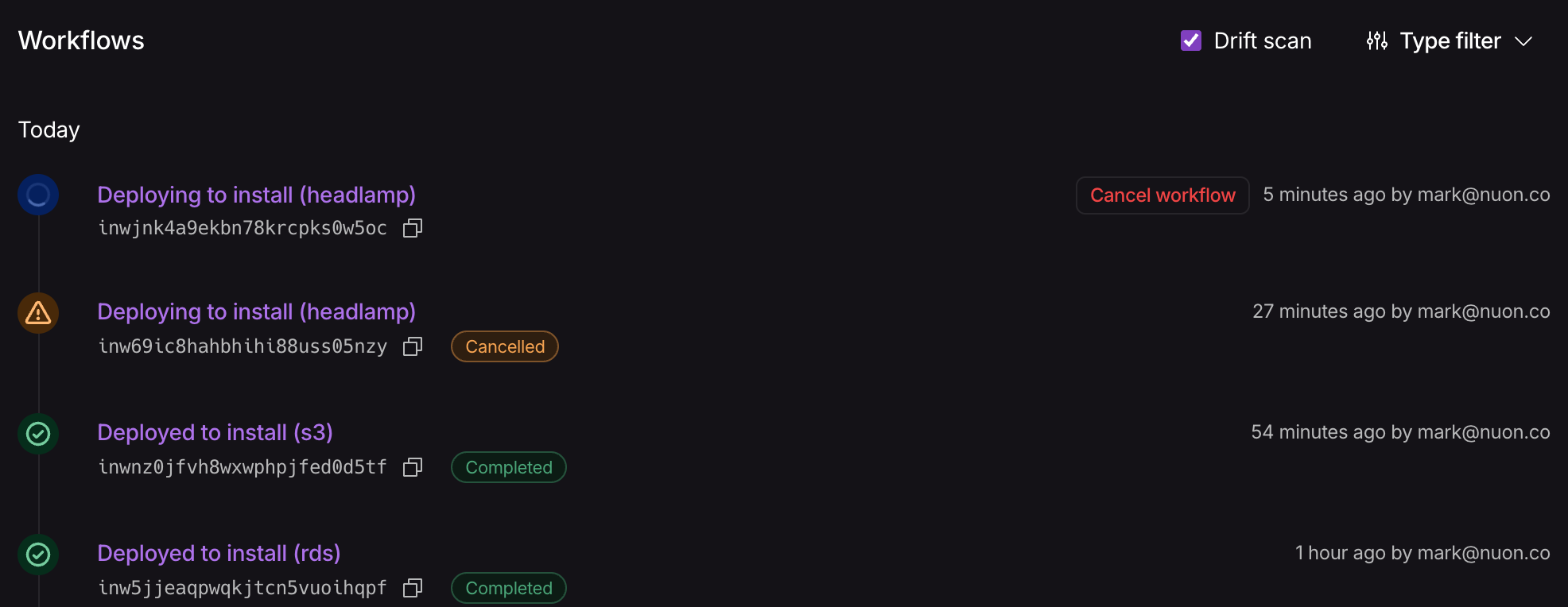
Why is a component workflow in a Pending state?
You probably have another workflow running. Workflows are currently single-threaded by design, to prevent collision.
Go into the install's workflow view in the dashboard, and cancel the other workflow that is still executing.
In this example, a Helm deployment has a pod in CrashLoopBackoff status, so after fixing the component and attempting to redeploy, it is pending until you cancel the failing component.
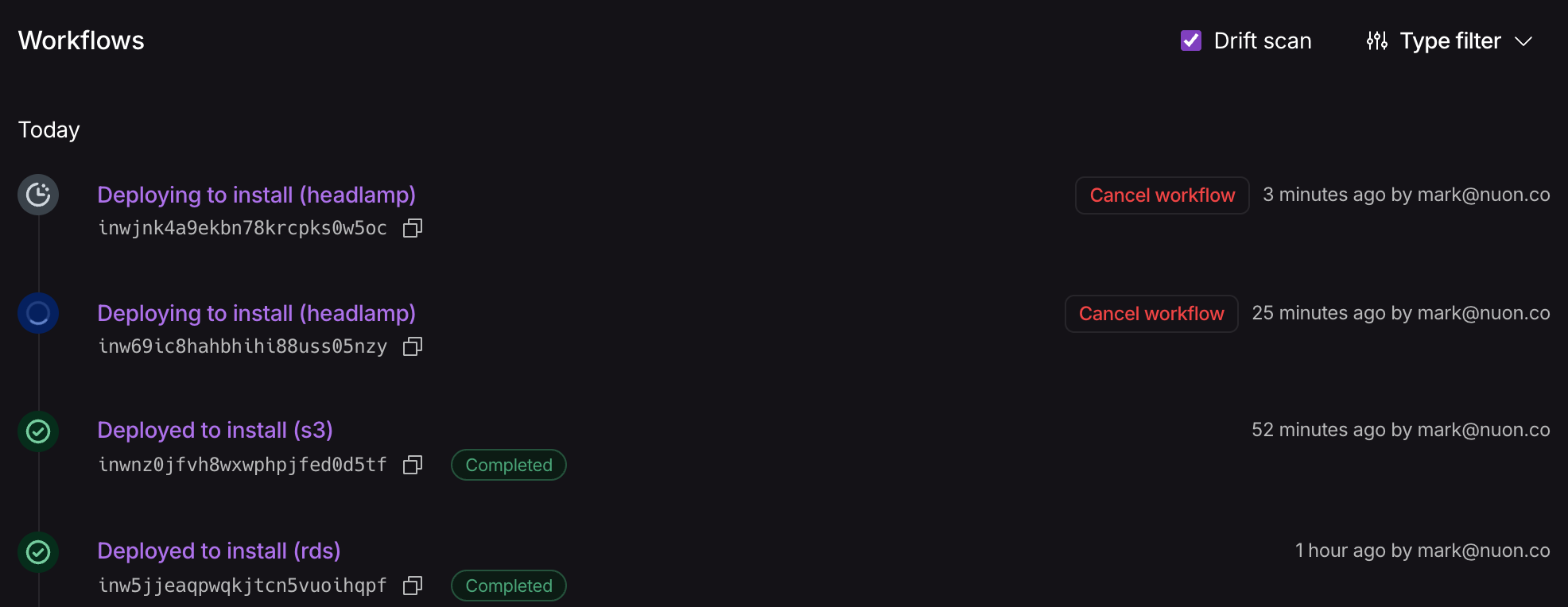
Components do have timeouts so eventual this would have failed, allowing the next workflow to execute.
With Nuon BYOC, does state stay entirely within our RDS, or does any state data transit through Nuon-managed infrastructure?
With Nuon BYOC, we intend that you cut off all access to Nuon. No data or state is stored outside your install and there is no dependency on Nuon Cloud. We do manage the install like a regular Nuon install, but you can turn the runner off so we have no permissions outside of a maintenance window.
Governance & Security
Can a customer's security policies be enforced?
Yes.
The vendor can share the Rego and Kyverno policies included in the app config that is used to install in the customer's VPC.
Alternatively, if the app config is configured to use the customer's existing VPC or Kubernetes cluster, their existing policy engine and policies will be applied to the app install.
Can customers enforce security policies in multi-cloud environments using Nuon?
Yes, Nuon integrates with Kyverno and Open Policy Agent (OPA) to enforce identity-based security policies across all deployed environments. Customers can define access restrictions, compliance rules, and resource limits dynamically.
The policies defined in the app are cloud-agnostic.
The Kyverno policies are defined in the policies.toml and policies sub directory at the root of your app configuration.
# policies

[[policy]]
type     = "kubernetes_cluster"
contents = "./disallow-ingress-nginx-custom-snippets.yaml"
Can customers enforce strict firewall rules to limit external access?
Yes, Nuon works within customer-defined firewall policies, including private subnets and VPN-based access controls.
The Nuon runner also only has egress-only access to the Nuon control plane so no ports need to be opened for Nuon to operate.
Split plane scenarios like AI, observability, and database apps can include VPNs like Tailscale for private connectivity between the vendor-hosted control plane and the customer-hosted data plane.
Can customers restrict Nuon’s access to their infrastructure?
Yes, customers of software vendors using Nuon to install their apps into customer cloud accounts, own and control the IAM roles that grant access.
The customer creates these roles when deploying the CloudFormation stack provided by the software vendor - and the roles are granted to the Nuon runner inside the customer cloud VPC.
The customer can scale down the ASG EC2 VM to turn off the runner and prevent access to the customer's cloud by the Nuon control plane.
Nuon operates under a least-privilege model, ensuring no unnecessary permissions are granted.
Can I route Nuon's phone-home and runner traffic through a URL I own instead of calling Nuon cloud directly?
Nuon supports custom URLs for both phone-home and runner-api.
In your runner.toml, point both values at a domain you own:
public_api_url = "https://runner.yourdomain.com"
runner_api_url = "https://runner.yourdomain.com"
This white-labels both Nuon URLs. To complete the loop, run a lightweight proxy inside your cluster that forwards those incoming requests to Nuon cloud. Nuon provides a simple Helm chart to stand this up, or you can build your own — reach out and we're happy to help configure it.
Why customers ask this: When you run Nuon in your own cloud (BYOC), the runner and phone-home script communicate with Nuon-owned endpoints. Many vendors prefer that this traffic egress through a domain they control so that (1) the endpoints match their own brand, and (2) they have a single, owned point where they can log, inspect, and audit everything leaving their environment. Routing through a proxy you own gives your security and platform teams direct visibility and control over that egress, which is often exactly what your own compliance review wants to see.
Can Nuon be integrated with existing identity providers for authentication?
Yes, Nuon supports OpenID Connect (OIDC) integration, allowing customers to use their existing identity providers for authentication and access control to the Nuon control plane.
Nuon Cloud, our SaaS offering, uses Auth0 as the Identity Provider (IdP).
Nuon BYOC, our Nuon-managed, vendor-hosted offering, supports any OIDC provider. e.g., Okta, Auth0.
Vendor apps deployed by Nuon into customer cloud accounts can continue to use whatever authentication and access control they require.
Can Nuon be used for hybrid or split-plane deployments where part of the application is in the vendor's cloud and part in the customer's cloud?
Yes, Nuon supports hybrid deployment models, allowing organizations to run part of their workloads in their cloud or on-premises environments while connecting securely to customer's cloud-hosted components.
This is useful for regulated industries requiring local data processing while leveraging cloud scalability.
Common use cases are AI, database, observability, or analytics apps where the customer wants to host the data plane but wants the vendor to host the control plane.
Here is an example app configuration that separates ClickHouse's control and data planes, with the data plane installed in a customer cloud.
Can you have different permission sets for initial deployment versus ongoing maintenance — rather than a single always-on permission?
Yes. Nuon calls these dynamic permissions. You define separate roles: a setup role used only during initial provisioning, a maintenance role with limited read-only access for normal operations, and an optional break-glass role that grants elevated access only when explicitly enabled by the customer. The Nuon Runner is the only entity that ever holds permissions in a customer environment during normal operation. Customers can enable or disable these roles from the customer portal, and in air-gapped installs can revoke runner access entirely.
Does Nuon Encrypt Data at Rest?
The Nuon Cloud data plane leverages PostgreSQL (RDS), Temporal, ClickHouse, and ECR for OCI artifacts.
All store data encrypted.
If Nuon's control and data plane are deployed into a vendor's cloud account, this infrastructure defaults to encrypted as well.
Does Nuon support cross-account access?
The runner does not use cross-account permissions. Instead, IAM roles are defined in the vendor's app configuration.
When the vendor initiates a customer install, the Nuon control plane generates a CloudFormation stack which the customer deploys into their cloud which creates a VPC, subnets and grants the IAM roles and permissions to the runner and not directly with the vendor.
Vendors can however implement cross-account access by defining a component that performs role delegation to a user in the vendor's cloud account.
How are secrets added to a customer install?
In the app's config, secret names and metadata (not the actual secrets) are added to the secrets.toml as part of the app configuration.
name          = "cockroachdb_admin_pw"
display_name  = "CockroachDB Admin PW"
description   = "Password for the default cockroachdb admin user. This password is used to access the cluster admin."

kubernetes_sync             = true
kubernetes_secret_namespace = "cockroach"
kubernetes_secret_name      = "admin-pw"
When the customer deploys the CloudFormation stack sent by the vendor, the customer is prompted to enter values for the secrets specified in secrets.toml, which are then stored in AWS Secrets Manager.
Adding of secrets is done entirely by the customer, in their cloud account. The vendor will never see those secrets.
If kubernetes_sync is set to true, Nuon has an additional workflow step to sync that secret to a specific Kubernetes namespace with the deployed app. This workflow step is run after the provisioning of a Kubernetes sandbox and uses the key of value when creating the Kubernetes secret.
You can reference secrets in components and actions using templating.
In Helm where the secret is synced to a Kubernetes namespace
# Helm values.yaml
...
service:
  port: 80
  targetPort: 3000

secrets:
  botTokenSecret: bot-user-oauth-token

# Helm template

apiVersion: apps/v1
kind: Deployment
...
      containers:
        - name: slack-app
          image: "{{ .Values.image.repository }}:{{ .Values.image.tag }}"
          ports:
            - containerPort: {{ .Values.deployment.containerPort }}
          env:
            - name: SLACK_BOT_TOKEN
              valueFrom:
                secretKeyRef:
                  name: {{ .Values.secrets.botTokenSecret }}
                  key: value
In a Terraform component where the secret is pulled from AWS Secrets Manager
# terraform
name              = "open_webui"
type              = "terraform_module"
terraform_version = "1.13.5"

...

[vars]
...
openai_secret_arn = "{{ .nuon.install_stack.outputs.openai_api_key_arn }}"
How do I convince my customers that Nuon is secure?
Nuon is a platform, with configurations at the control plane and your app-level, to make it secure and trustworthy for your customers.
Secrets and sensitive values are entered by the customer and stored in AWS Secrets Manager, and never accessible by you (the vendor) and only accessed by the Nuon runner which is isolated in the customer's VPC.
Nuon actions — scripts that the runner executes in the customer VPC — are logged by Nuon, so the maintenance and break-glass IAM roles defined in the app configuration must be scoped properly to prevent accessing resources that they should not have access to.
Nuon's control plane does not have to run in Nuon's cloud. Nuon BYOC is our offering where Nuon's product deploys Nuon's control plane in the vendor's cloud account. This allows their customers to only have to trust and verify the vendor's cloud and not another cloud like Nuon.
See this docs link for more information about Nuon security & trust.
How do I test Nuon without accidentally giving you customer credentials or production AWS tokens?
Nuon cannot directly access any AWS account — only the runner inside the customer account can. Recommended approach: use a fresh/throwaway AWS account and do the one-click install via the AWS console.
How does Nuon address security and day-two operations concerns for BYOC vendors?
Nuon places a runner in the customer account alongside the installation. The runner handles deploys, health checks, and monitoring without requiring the vendor to have direct access. Customers can disable or remove the runner's permissions at any time. Nuon also does drift detection - monitoring customer environments for changes made outside of deployments that could create risk or break the application.
How does Nuon handle customer requests for a Software Bill of Materials (SBOM) for deployed services and components?
While Nuon does not generate SBOMs, our policy engine can detect and enforce SBOM.
e.g., Policy examples vendors using Nuon can enforce:
"Require all images to have an SBOM before deployment into customer VPC"
"Only allow CycloneDX format SBOMs"
"Block deployment entirely if no SBOM is present"
You the vendor would need to come up with SBOM yourselves for each individual image component and Nuon can help your customers verify with policies. This can be particularly important due to the executive order in US & upcoming regulations in EU with CRA.
Is Nuon SOC 2 Type II certified?
Nuon is pursuing a SOC 2 Type II report scoped to the Security Trust Service Criteria. We are actively implementing controls and preparing for our audit, with continuous compliance monitoring in place via Drata.
You can review our security posture, controls, and subprocessors today at Nuon's Trust Center: https://trust.nuon.co. The SOC 2 report will be available there to request once our audit is complete.
Our Terraform requires extensive IAM permissions. If Nuon is running our Terraform, how do we enforce the customer's permission controls, since our Terraform could provision a role with full
Two models: (1) Move IAM creation into the CloudFormation stack so the customer manages those permissions themselves. (2) Define IAM boundary policies that govern what types of roles/policies your Terraform is allowed to create. The CloudFormation stack is where the customer decides what they allow; Nuon then executes your Terraform within those boundaries.
What are common customer security concerns around BYOC day-two operations?
Customers require release windows for upgrades, audit trails on all changes, and guarantees that deploys will not accidentally destroy data (e.g., recreating a database). Direct vendor access to customer environments is often not allowed for security or compliance reasons.
Will bringing in Nuon trigger a security review from our customers?
It might, but here's what to tell them:
The runner is open source so they can inspect exactly what runs in their account. No data flows to Nuon's cloud — we are not a data sub-processor.
And Nuon is white-label by default, so our name doesn't have to appear anywhere in the customer experience.
CLI, Configuration & TOML
Can I use AI to build a Nuon app configuration?
Yes, you can use any terminal-based AI agent to learn from other Nuon example app configs, sandboxes, Nuon's docs, and Nuon's OSS repo — to quickly build TOML files that comprise a Nuon app configuration.
See our docs for more information about our AGENTS.md and CLAUDE.md files in our example apps repo.
Do you have pre-built recipes or templates for common enterprise requirements like VPC peering, customer-managed encryption keys, SIEM integrations, or certificate authority flows?
Yes. Nuon maintains open-source sample apps for common patterns including VPC peering, SIEM integrations, Temporal, ClickHouse, control plane / data plane splits (e.g., using a tunnel to reach the data plane), and certificate handling. These aren't fully productized as one-click templates yet, but they serve as starting points. In a forward-deployed engagement, Nuon's team helps adapt these to the vendor's architecture during the POC.
How do I configure my app to install on multiple clouds?
The cloud is defined in the sandbox so you would define an app for each cloud.
In the app configuration, you specify the sandbox in the sandbox.toml
# sandbox

terraform_version = "1.11.3"

[public_repo]
directory = "."
repo      = "nuonco/aws-eks-sandbox"
branch    = "main"
Nuon provides AWS and Azure sandboxes in our GitHub nuonco.
How do I create an app?
You create the app with the CLI.
nuon apps create -n <app name>
You should make the app name the same as the directory name which is required for the subsequent nuon apps sync step.
How do I delete an app?
If there are no installs based on an app, you can delete it and its components and actions with the CLI.
nuon apps delete -a <app name> --confirm
It will take several seconds as it also deletes the components first, so refresh the dashboard UI or nuon apps list.
For new trial users or in development environments where you are iterating on an app, there is a handy command to clean up your Nuon org.
How do I sync my app to the Nuon control plane
You sync the app with the CLI. You must first create the app with CLI as well.
nuon apps sync
You must be in the directory of your app and the directory name must match the app name.
How do I update an app?
Update the TOML files of your local app.
You then update the app with the CLI.
nuon apps sync
You must be in the app directory and it must be the same name as your app in the Nuon control plane.
If we already have our Terraform and modules, do we have to split them up as separate Nuon components, or can we leave them as one?
No requirement to split. Nuon is agnostic. You can keep a single root module as one component. Splitting is useful to make the component dependency graph visual and to speed up updates when only upstream pieces have changed — but there's no loss from keeping everything together. Action triggers (pre-deploy, post-deploy, post-fail) and troubleshooting actions all work at the component level regardless of how many components you have, so a single component gets everything.
What happens when I sync an app?
Syncing an app performs validation of the syntax of the app's TOML files.
The Nuon control plane creates builds for each component. A build creates an OCI artifact that is stored in the Nuon org's container registry like AWS ECR.
The artifacts are used by Nuon to provision and update an install in the customer's cloud.
If you update the app's configuration, you must run nuon apps sync to trigger a re-build of any changed components.
Nuon automatically detects and re-builds components if their TOML files or referenced files like Helm values change.
However, you must manually rebuild in the dashboard (or with the CLI) when:
Git repository source code changes (e.g., Terraform modules or Helm charts)
Source code in your app repository changes (push your branch first, then rebuild)
Action scripts are not built into OCI artifacts and stored in a container registry but rather are stored in the Nuon data plane and retrieved during an install workflow step.
Why do I get an unable to render: unable to execute template error when deploying a component?
You may have incorrect templating/interpolation when referencing outputs from a component. In particular, be sure outputs is part of the templating.
# correct
cluster_arn             = "{{ .nuon.components.cluster.outputs.cluster_arn }}"

# incorrect
cluster_arn             = "{{ .nuon.components.cluster.cluster_arn }}"
Why do I get an undefined resource RunnerDeprovision when deploying the AWS CloudFormation stack?
You probably built a Nuon app from scratch, and are missing the permissions directory with the TOML files defining the runner's IAM roles and permissions.
deprovision.toml
deprovision_boundary.json
maintenance.toml
maintenance_boundary.json
maintenance_policy.json
provision.toml
provision_boundary.json
Copy the permissions directory from one of Nuon's sample apps.
Nuon provides these IAM roles as examples and you and your customers should define the required permissions for your app. In general, provision and deprovision need the highest permissions to create and destroy cloud resources. Maintenance and break glass roles can be scoped accordingly.
A best practice is to copy an existing sample app and tweak values. Alternatively, point your coding agent to the sample apps repo and instruct it to build an app based on the example apps with types of components and infrastructure needd.
Customer Day-2 Operations
Can customers self-manage their deployments through Nuon?
Nuon has a beta customer dashboard where customers click vendor-initiated install links that prompt for any customer facing inputs.
Contact sales if you are interested in this beta feature.
Customers are asking to see a changelog before each deployment. Do you have that?
There's an audit log and deploy activity view. A formal per-version changelog/notes feature isn't first-class yet but it's prioritizable.
Do we need a separate observability tool to collect logs?
Besides bundling your observability product of choice into your Nuon app config, you can use Nuon action scripts to execute commands in the customer's VPC.
Logs are returned and stored in the Nuon data plane.
Software vendors can have Nuon deploy the Nuon control and data planes into their cloud account so no log data is stored in Nuon's cloud.
Do we need dedicated infra engineers just to onboard customers
You shouldn't need to staff a dedicated infrastructure engineer for every enterprise BYOC onboarding. That's the tax you're paying when you're doing it manually. That's what Nuon is automating.
Does Nuon provide log aggregation for troubleshooting?
Yes, Nuon collects infrastructure logs for an install's sandbox, components and actions.
The vendor can view these logs in the dashboard.
Be default, Nuon does not collect application-level logs from the vendor's app.
If you use action scripts to debug and troubleshoot, e.g., kubectl or psql, log results will be stored in Nuon along with infrastructure logs. You can scope the permissions of the Maintenance IAM role to prevent what resources the vendor can debug or touch.
How can I pass an output from one component to another component or action?
Nuon uses Go templating, so add the component output into the other component or action.
Below is a health check action TOML file with an environment variable called ENDPOINT that takes the EC2 component's public_ip output variable as a default value.
[steps.env_vars]
ENDPOINT = "{{.nuon.components.ec2.outputs.public_ip}}"
Here is the ec2 component's Terraform outputs.tf with the public_ip
output "public_ip" {
  value = module.ec2_instance.public_ip
}
How do I troubleshoot without shell access?
When you navigate to an install, under the "Manage" dropdown, there's an option to "Run adhoc action".
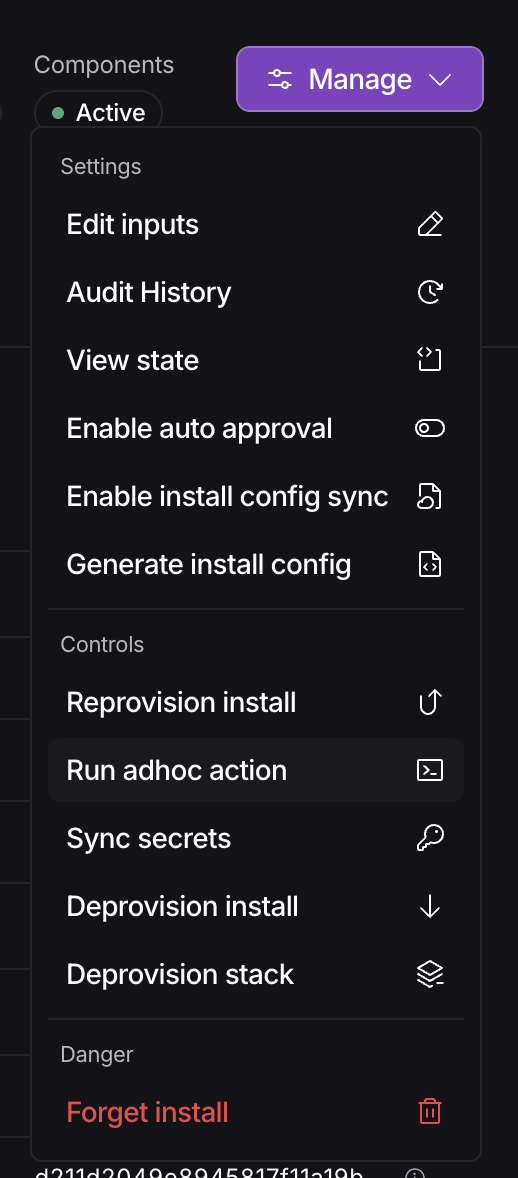
These don't require writing/syncing a TOML file and can be run directly from the UI. They can be one line shell commands or multiline scripts. Anything that would go into an action TOML file's inline_contents attribute can be used here.
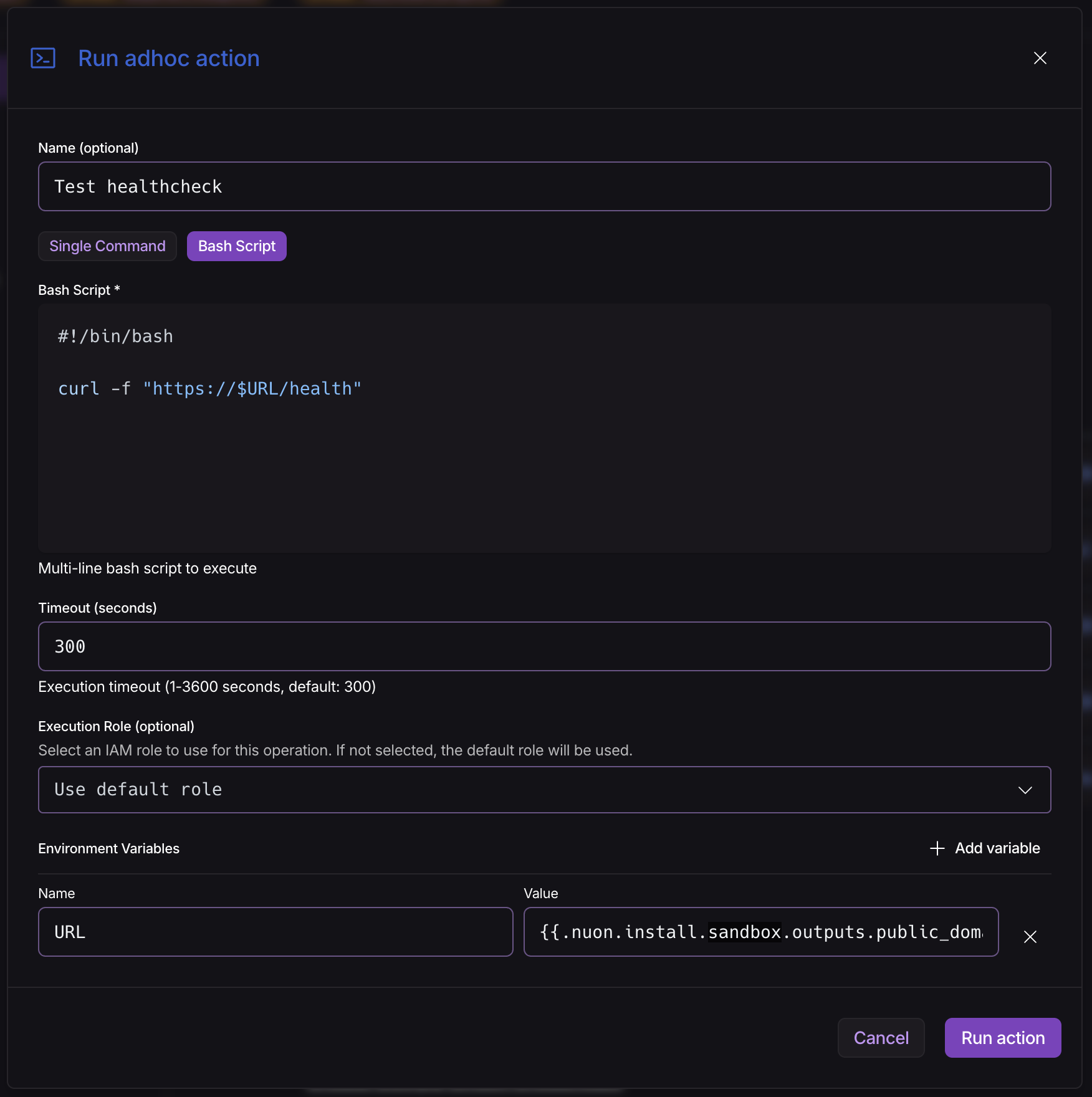
After the action executes, you can click "Edit and rerun" to iterate on your script.
How do logs and metrics get back to the vendor?
Two patterns. Either deploy an OTEL collector inside the customer environment (with their permission) and stream continuously, or write on-demand actions that fetch logs only when needed. Most vendors start with on-demand because of customer sensitivity around PII and data egress. Nuon itself speaks OTEL, so logs can also be forwarded through the runner's control plane connection.
How do we debug when something goes wrong? Can we get into a customer's AWS console?
Nuon provides Actions — packaged operational scripts that run inside the customer account under governed permissions with a full audit log.
You define health checks, runbooks, and ad hoc commands your team runs from the control plane.
For elevated access, Break Glass lets customers temporarily grant elevated permissions.
As an escape hatch, role delegation (via a component) can grant your team direct access (e.g., kubeconfig) to customer resources, completely bypassing Nuon.
How do we handle concerns about vulnerability scanning of our app by customers, potentially flagging "false positives"?
There are open standards like VEX (Vulnerability Exploitability Exchange) that you as the vendor can use so scanners ignore them. Almost all scanners these days are aware of it.
All you would need to do is attach a VEX document alongside your OCI artifact for scanners to ignore it.
How do we run ad-hoc commands during an incident?
From the Nuon UI you can fire ad-hoc commands through the runner. Output is captured and audit-logged.
How do we run incident response without direct SSH or kubectl access?
A shared Slack channel between vendor and customer is standard. The vendor defines debug actions for read-only visibility, and the customer can enable break-glass to elevate permissions for the duration of the incident. Everything is audit-logged.
How do you manage bundling and release windows? Customers say you can only deploy between 7–9pm.
Customers currently build release windows via the API. First-class git branch + release window support is on the short-term roadmap. App branches feature will let you connect repos and auto-update installs on rules.
How does Nuon handle complex one-time or periodic operational steps that require coordination across environments — things like certificate issuance, key material transfer, or rotation workfl
These are handled through Actions — custom scripts that the Nuon Runner can execute inside the customer account, triggered by lifecycle events (pre-deploy, post-deploy) or run manually. Actions can call into the vendor's infrastructure with scoped, temporary permissions to fetch key material, inject it into the customer environment, or perform orchestration steps. They can also be used for things like database migrations: fetching a dump from an existing environment, staging it in a pre-signed bucket, and importing it into the new install — all without requiring standing permissions to the customer account.
How does Nuon provide real-time monitoring for deployed environments?
If a vendor's customers are ok with it, the vendor can include an observability tool's agent as a component in the app configuration — to monitor the vendor's app. Example observability tools include Datadog, Grafana, Honeycomb, SolarWinds.
The agent then sends logs and metrics to the observability provider's cloud.
The runner frequently sends its status to the Nuon control plane.
How does Nuon work alongside an existing Flux or Helm-based workflow?
They run in parallel during the transition. GitHub Action patterns exist for creating ephemeral installs on every PR to validate the provisioning cycle end-to-end.
If a customer is down and the Nuon control plane is also down, we can no longer execute scripts to fix it?
Correct — that's the dependency. That's why role delegation (escape hatch) exists so you can operate directly in the customer account independent of Nuon.
If I add a new component to an app do I need to manually trigger a deployment of all components on each install?
When you nuon apps sync, the new component will be built. But yes, you will need to deploy it and any dependents to each install.
If we need separate monitoring stack outside of nuon - does that mean customer need to have 2 different cloud accounts to connect externally?
The software vendor's customer needs to white label the IP addresses of the Nuon control plane and the observability vendor's cloud.
If we use Nuon, are we painting ourselves into a corner?
No. You can run any operational command through Actions (with audit log). If Break Glass isn't enough, you work with the customer for direct cluster access. Critically, Nuon does NOT sit in the critical path of customer uptime — if the Nuon control plane goes down, customer environments keep running; you only lose the ability to push updates or run actions until it's restored.
We need to make calls back to our cloud (e.g., accept PSC connections). Can Nuon do this from inside the customer account?
Yes via actions. Actions are scripts that run from the runner inside the customer environment. The action fetches credentials from your account as a secret, then uses them to make the callback.
Alternatively, use Nuon's webhook system — trigger a callback when an install comes online so the vendor-side automation handles the handshake.
What are app branches?
A feature that lets many installs track a single git branch. Changing the branch — bumping a helm chart or Kubernetes version — automatically reconciles every install tracking it. Foundation for continuous delivery across a fleet.
What are release windows?
A scheduled window during which a customer accepts updates. Outside the window, the install is frozen. Useful when customers want a predictable upgrade cadence (monthly, quarterly).
What does Nuon add beyond what our existing CI/CD pipeline does, especially for enterprise compliance?
The value is primarily day-2. Once deployed, the Nuon runner lives inside the customer account alongside the app.
From there: health check probes run inside the customer environment without cross-account access, runbooks codify multi-environment operations (e.g., adding a database across 100 installs simultaneously), drift detection catches configuration divergence, policy enforcement governs what gets deployed, and there's a single pane of glass across all single-tenant and BYOC installs.
The runner-based model also gives the customer control — they can enable or disable the runner, which removes the need for the vendor to have persistent cross-account access.
What happens if the app needs enhanced vendor access?
The runner assumes the maintenance role when executing action scripts to troubleshoot and debug.
Vendors can define a break glass role with additional permissions than the maintenance role — to execute more expansive action scripts.
These roles are granted by the customer through the Stack and can be revoked at any time.
What is break-glass?
A pattern where the customer grants the runner additional, time-bounded permissions during an incident or planned operation. After the session, the customer revokes them and the audit trail is shared back.
What is drift detection?
Nuon continuously checks the deployed infrastructure and application state against the desired state in the app config. If a customer deletes or modifies something out of band, drift is surfaced and you can reconcile.
What's a runbook?
A composed sequence of actions and state, pulled together into an operational playbook. Used for incident triage, database migrations, multi-step diagnostics.
What's an action?
A script that runs inside the customer environment via the runner. Used for health checks, debug commands, migrations, secret rotation — anything day-2. Every execution is auditable.
Would every interaction we have with our customers' clouds be intermediated through Nuon?
Not necessarily. Role delegation (direct access to customer AWS via your team's identity) is fully supported. Nuon is the managed path; the escape hatch is always available.
Control Plane Deployment Options
Can I install Nuon in our cloud?
Yes, we use Nuon to install the Nuon control plane in a software vendor's cloud. The software vendor must be a qualified prospect or a customer with a paid license.
This offering is called Nuon BYOC.
Can I run Nuon air-gapped?
At the moment, no. We have a roadmap item to remove AWS dependencies from our control plane and documented Helm charts to install the Nuon infrastructure.
Presently, Nuon can only install the Nuon control plane into a software vendor's AWS cloud. This offering is called Nuon BYOC.
So Nuon-managed, self-hosted.
The software vendor could scale down the AWS ASG VM once the Nuon runner has completed the install of the Nuon control plane, so air-gapped after the install.
The software vendor could scale up the ASG VM to let the runner upgrade Nuon on occasion.
Can I self-host Nuon?
Presently, Nuon can only install the Nuon control plane into a software vendor's AWS cloud. This offering is called Nuon BYOC.
So Nuon-managed, self-hosted.
We have a roadmap item to remove AWS dependencies from our control plane and documented Helm charts to install the Nuon infrastructure.
Can Nuon deploy on-premises?
No. Nuon's control plane can currently only deploy into AWS, Azure, and Google Cloud.
Customer installs done by Nuon can also only deploy into AWS, Azure, and Google Cloud, and not on-premises.
Does Nuon have a SaaS offering?
Yes, our SaaS offering is called Nuon Cloud.
Sign up for a free trial here.
Does Nuon have full access to a Nuon BYOC?
No, Nuon will not have full access to a production Nuon BYOC instance.
For some customers, they deploy a dev instance of Nuon BYOC and give Nuon more access, in particular, as users in their org instance, for easier troubleshooting.
How can I check whether Nuon Cloud is up, degraded, or down?
Check the status page first: https://status.nuon.co is the single source of truth for real-time and historical status of Nuon Cloud. It shows one of three states — operational (everything healthy), degraded (partial or slow service, some functionality impaired), or outage (a component is down) — per component.
What's covered: the status of each Nuon Cloud service, including the control plane, runner API, phone-home, builds and deploys, and the dashboard. During a degraded or outage event you'll see the affected components, a description of impact, and live updates as we work the incident.
Subscribe for proactive alerts: on status.nuon.co you can subscribe to get notified (email, SMS, webhook, or RSS) the moment a component goes degraded or into an outage, and when it's resolved — so you don't have to check manually.
Status page vs. your install: the status page reflects Nuon Cloud (the control plane and shared services), not the health of your own application install running in a customer's VPC. If Nuon Cloud shows operational but you're seeing problems in your environment, check your install's dashboard and logs; the issue is likely local to your install, not a Nuon Cloud incident.
Review past incidents: the status page also keeps a history of prior degraded and outage events with resolution details, so you can review uptime and past post-mortems.
If it's not on the status page: if you're experiencing an issue that isn't reflected as degraded or outage on status.nuon.co, reach out to Nuon in Slack and include your org ID, install ID, and the timestamps you observed so we can investigate quickly.
If we deploy Nuon's control plane with Nuon BYOC, is the database data encrypted?
Yes, by default, database (PostgreSQL) encryption is on.
Is Nuon open source?
Yes, Nuon is open source with an AGPL-30 license.
The GitHub repository is here.
Nuon was developed several years ago, but recently open-sourced in December 2025.
We are currently working on removing AWS dependencies so that Nuon can be self-hosted or run in a fully air-gapped environment.
What are the advantages and limitations of Nuon Cloud vs Nuon BYOC?
Startups often Nuon Cloud because they have very few customers and do not want to incur the cloud expense, since Nuon is a beefy stack including Temporal, RDS, and ClickHouse.
Nuon BYOC is where Nuon deploys the Nuon control and data plane into your AWS cloud account.
Established vendors like Nuon BYOC because they control Nuon in their AWS and do not have to rely on Nuon's cloud. They also benefit from Nuon managing their Nuon deployment versus self-hosting Nuon.
You must be a licensed Nuon customer to use Nuon BYOC. Contact sales and share your use case and requirements.
What deployment model variability do vendors face when offering BYOC to their customers?
Significant variability. Some customers want Docker images and instructions to self-manage everything. Others want to create a dedicated cloud sub-account or use VPC peering and let the vendor manage deployments there. A third pattern is recursive BYOC - where a vendor's customer is itself a BYOC platform, requiring the ability to bundle the vendor's software and offer that full bundle as BYOC downstream.
End Customers & Enterprises
Can we run Nuon in-house to standardize how all of our vendor apps are deployed?
Yes.
That is one of Nuon's use cases.
Nuon is an open-source platform to deploy and manage any cloud-native software app into AWS, Azure, and Google Cloud.
So Nuon can manage vendor and in-house software apps.
Could Nuon attach to an in-house vendor app?
Yes.
The DevOps and Cloud Engineering team would configure an app in Nuon's TOML file format, pointing to existing scanned vendor container images, Helm charts, Terraform and day-2 scripts.
Then install the vendor onto the cloud provider of choice for specific departments, regions, or divisions.
Could vendors be adversaries of Nuon and put contractual language to prevent their apps from being deployed by Nuon?
No.
When customers self-host a vendor's software there is no restriction on what tooling is used to deploy and manage their software.
Do we have base images for vendors' products?
If a vendor uses Nuon, they manage their images in Nuon. The same goes if an enterprise uses Nuon to deploy vendor apps - you'd point Nuon to your scanned images.
Do we have to use your cloud?
No, Nuon Cloud is for startups and the self-service trial as part of our product-led growth strategy and open source. We deploy Nuon control plane into the customer's private cloud. This can be done by Nuon using Nuon, or self-hosted with Helm charts.
The infrastructure includes ClickHouse, Temporal, PostgreSQL, our Go API service, and React-based front-end.
Does Nuon, the vendor, and the end customer have to hold hands to make BYOC work?
If depends on where Nuon is licensed and installed.
Scenario #1: End Customer Deploys Nuon's Control Plane
If the end customer licenses and deploys Nuon, their DevOps and Cloud Engineering staff configure Nuon apps for each vendor's software that they currently self-host.
They benefit from a standard, and cross-cloud way to install and manage their apps.
Scenario #2: The Vendor Deploys Nuon's Control Plane
If the software vendor licenses and deploys Nuon, they configure their app for Nuon, and contractually work with their customers to install and manage their app in the customers' cloud accounts.
Vendors benefit from an incremental revenue stream besides SaaS and self-hosted, and end customers benefit from meeting data residency requirements and shifting the management of the app to the vendor.
How open is the platform?
Besides being open source, Nuon is pluggable by design, supporting all 3 clouds, Terraform, Kubernetes, Helm, S3, etc.
Since it's egress-only, does the UI have a way to talk with the install's cloud?
Our agent (runner) is provisioned by the target cloud with a stack like CloudFormation and polls the Nuon control plane for jobs to deploy or upgrade the vendor app, and perform day-2 ops like run scripts.
What are the most common vendors we see leveraging BYOC?
Database, Internal Tools Builders, Observability, AI - basically any vendor with a sensitive data plane component and with regulated industry customers.
What's your take on vendors claiming to offer BYOC?
BYOC is a relatively new deployment option, so there are varying styles and approaches to vendor's offering BYOC.
If there isn't documentation on the vendor website, contact their sales team to learn more.
Questions you should ask include:
Which clouds they can deploy into?
Is there a multi-year commitment?
How automated is their BYOC approach or is it heavily services-based?
Do they require cross-account access or do they have an agent approach like Nuon?
Are the control and data planes in the customer's cloud?
You are welcome to recommend the software vendor contact Nuon to learn about using our platform for their BYOC offering.
Alternatively, consider investigating Nuon for use inside your enterprise to more easily and securely install and manage your vendor and in-house developed apps — across multiple cloud providers in your private VPCs.
Contacts & Purchasing
Can I buy Nuon from a cloud's marketplace?
No.
Contact sales about licensing Nuon.
Nuon Cloud can install Nuon's control plane on AWS, Azure, and Google Cloud, but there currently is an AWS dependency.
How do I license Nuon?
Nuon has a Master Service Agreement (MSA) which includes:
Subscription Period (minimum 12 months)
Deployment Model (Customer or Provider-Hosted)
License items and quantities
Fees
Standard Terms
The license includes a platform fee to run Nuon in your account, plus metered/seat-based pricing based on number of installs planned.
The Deployment Model includes a specific Schedule with Provider and Customer Responsibilities and Exclusions.
To learn about pricing and fees, contact sales.
Is Nuon FedRAMP Authorized?
Nuon is FedRAMP compliant but not authorized, since we're self-hosted software. We support deployments on FedRAMP-authorized infrastructure.
What does pricing look like?
Nuon charges a platform fee that covers forward-deployed engineering resources, support, and deployment of Nuon itself into the vendor's cloud account. On top of that, metering is based on the number of customer installs. POC engagements typically involve an upfront commitment to a target install count, with the option to expand from there.
What is the cost benefit of BYOC for vendors' customers?
When a vendor deploys into a large customer's cloud account, the customer leverages their existing cloud provider savings plans and committed spend, resulting in lower total cost of ownership compared to the vendor running it in their own cloud and passing costs through.
Contacting Support
Can Nuon employees access my Nuon instance?
Nuon Cloud
Nuon Cloud is a multi-tenant offering of Nuon in our AWS infrastructure. Free trials and smaller-size licensed customers operate in Nuon Cloud.
Nuon has organizational access to troubleshoot a customer's org instance.
Nuon BYOC
Nuon BYOC is where Nuon deploys and manages an instance of Nuon's control plane in a software vendor's cloud.
Nuon will have access to troubleshoot and update Nuon.
Customers can temporarily disable the Nuon runner by changing the desired capacity of the AWS Auto Scaling Group to 0 which will shutdown the EC2 instance with the Nuon runner.
How do I Contact Nuon Support?
Open Source Support
Nuon supports users of its open source project nuonco/nuon through our Slack community.
You can sign up here: Nuon's Slack community
Feature requests and bugs should be created as GitHub Issues in our open source repository.
Licensed Customer Support
Nuon supports licensed customers with private, shared Slack channel.
Please contact sales to set that up.
How do I join the Nuon Slack community?
You can sign up here: Nuon's Slack community
General
As a vendor, how do I provision new secrets on the CloudFormation after it's already created by the end customer?
If you update the secrets, you will need to re-provision, but you don't need to re-create everything. There is a CloudFormation flow to update a stack w/ the new template. the template generated for the re-provision can be used to update the stack. we suggest using the "create a change set" in the AWS console.
fire off the re-provision flow from the Nuon dashboard
copy the new stack template
go to the CF stack in the AWS console and select the root stack
click "Update stack" > "Create a change set"
replace the template w/ the new template
This flow will only update the resources that have changed. e.g., it will add the new secrets.
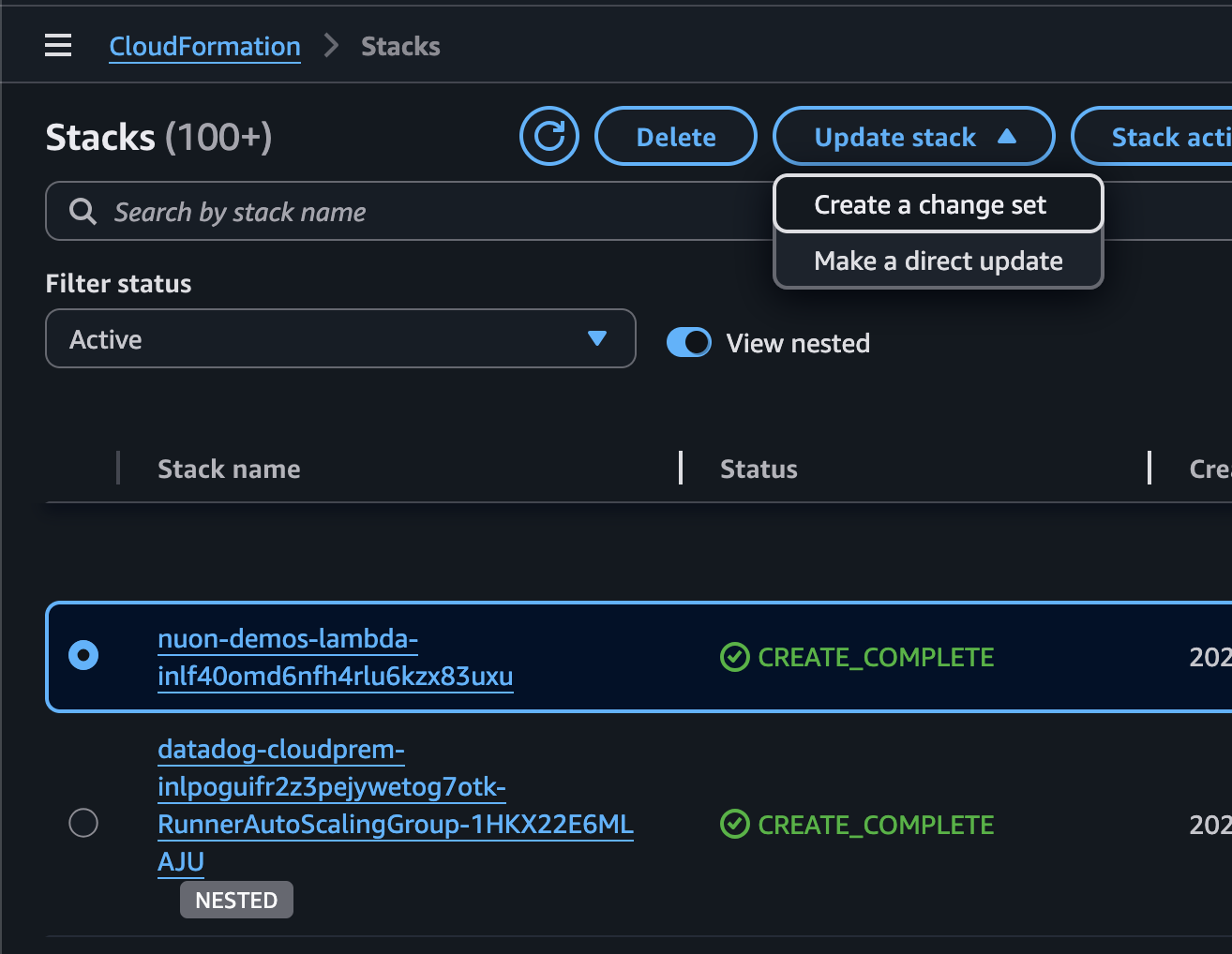
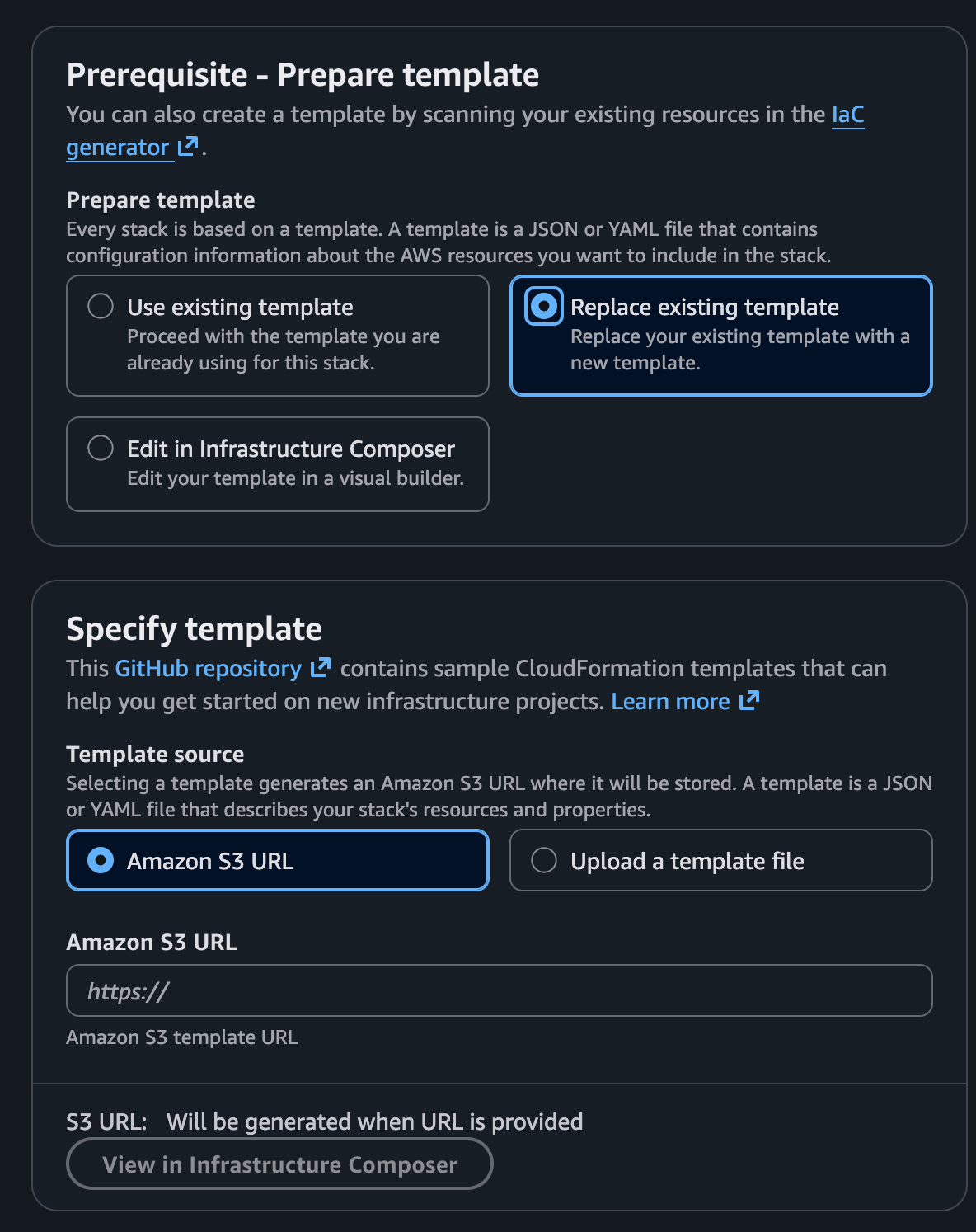
Working with Nuon
Does Nuon dogfood its own platform?
Yes. Nuon deploys Nuon into customer environments using Nuon. Vendors who want a fully isolated control plane in their own account can run Nuon-on-Nuon themselves.
How does Nuon differentiate from Ryvn, Replicated, and Omnistrate?
Nuon focuses on deploying software vendors' products into customers' cloud accounts like AWS, Azure and GCP versus on-premises and bare metal data centers.
Key differentiators are an egress-only runner model in the customer account, day-two operations like release management, debugging, health checks, infrastructure policy management, and drift detection.
Nuon's target market are startup to established software vendors who sell to regulated enterprise customers.
Nuon is also open-source, for transparency and trust and the GitHub repository is https://github.com/nuonco/nuon
What does a typical POC engagement look like?
Nuon sets up a shared Slack channel and reviews the vendor's architecture (typically via access to relevant infrastructure repos). Within one to two weeks, Nuon produces a working version of the vendor's application packaged as a Nuon app — not necessarily every component, but enough to evaluate the core provisioning and operations flow. The vendor then kicks the tires, Nuon shares the app config, walks through install creation, and both sides iterate on customizations and edge cases together via Slack.
When should I start testing BYOC?
As early as possible. Spin up a fresh AWS account, deploy your app into it using Nuon Cloud, and start releasing alongside your cloud. You'll learn how it fails and what visibility you actually need before a real customer is involved.